
Invasive shrubs
Land Clearing Springfield MO: Bush Honeysuckle Removal in Springfield
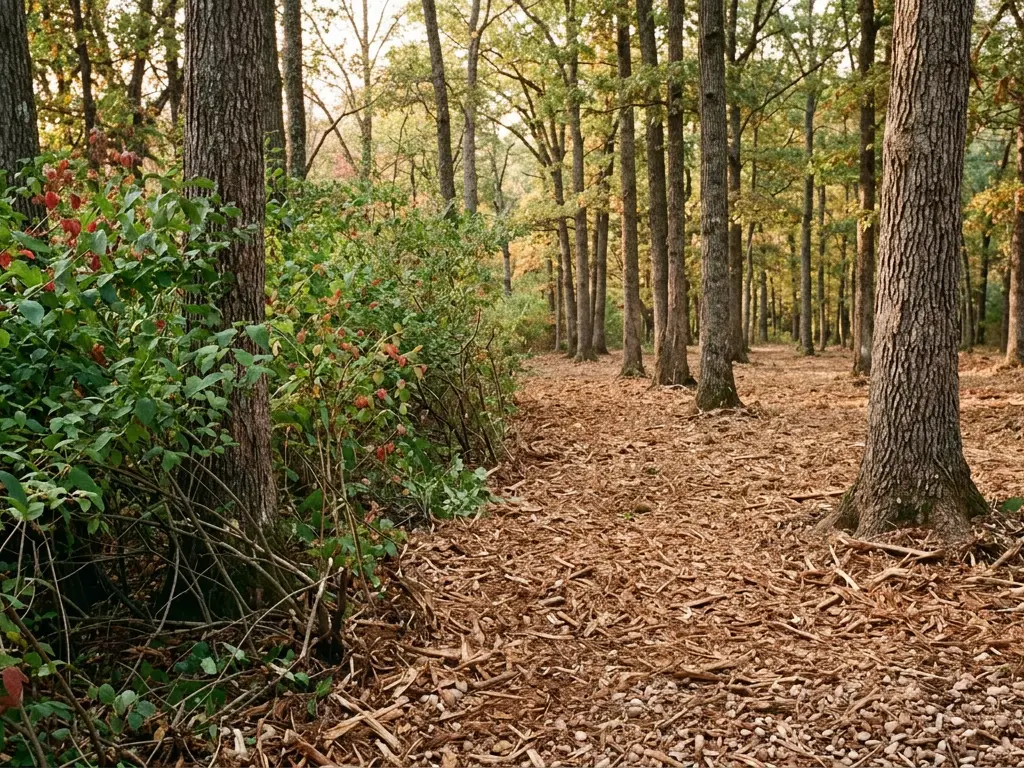
The green wall under the oaks in November is bush honeysuckle. It comes back from the stump, so removal is a two-step job.
- Springfield and 10 nearby townsGreene and Christian County, all within 20 miles
- Licensed, insured local contractorsWe work with them; ask for proof before work starts
- Written price firstPer-acre ranges published on every service page
- Calls answeredMonday to Saturday, 7am to 6pm
Land Clearing Springfield MO arranges bush honeysuckle removal for wooded lots, fence rows and acreage around Springfield. The Missouri Department of Conservation names two shrub species, Amur and Morrow's honeysuckle, as the invasive honeysuckles causing the most problems in the state. Both were planted as ornamentals and now form dense thickets that shade out native plants and tree seedlings, and both resprout hard when they are simply cut.
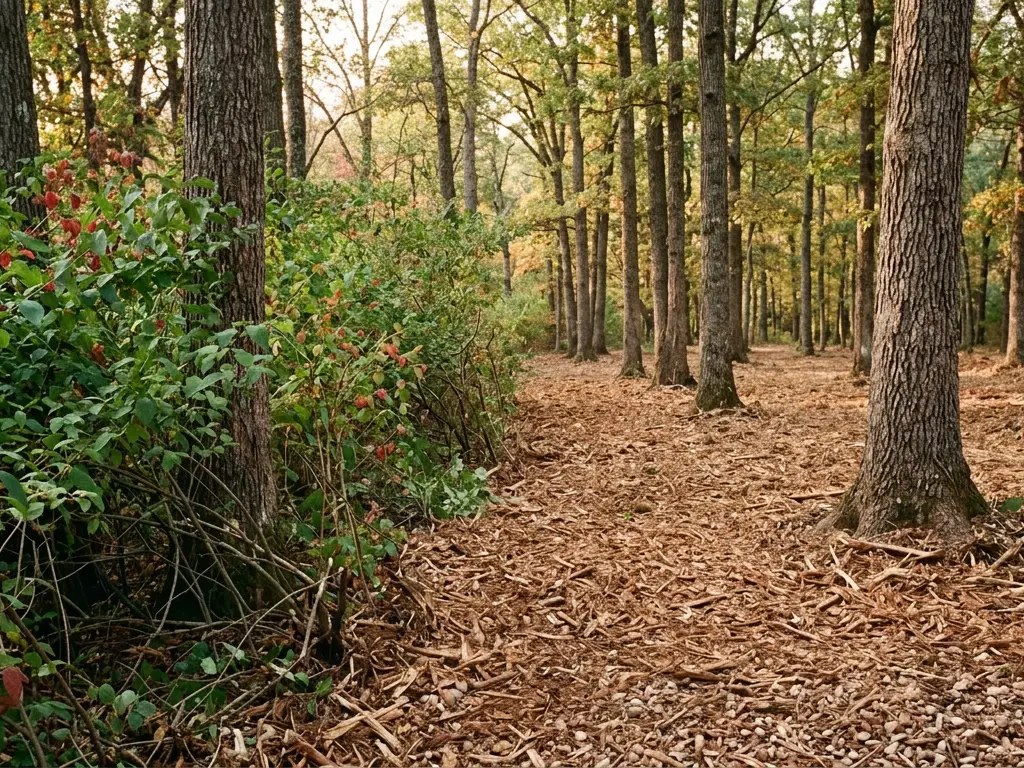
Mulching honeysuckle out of the understory runs $400 to $2,000 an acre depending on density; cut it without treating the stumps and it is back as a denser thicket in two or three years, and you pay $1,600 to $3,000 an acre again as heavy brush.
Typical price
$400 to $2,000 an acre
Forestry mulching averages $400 to $800 an acre and up to $2,000 an acre on dense overgrowth (HomeGuide, September 2023), and most honeysuckle thickets are at the dense end. Hand cutting and stump treatment around trees you want to keep adds labor; ask for it to be priced separately from the mulching.
Get a price: (417) 759-5914How to tell it is bush honeysuckle
- Shrubs leafing out first in spring and staying green into late fall
- Arching stems 6 to 20 feet tall with paired oval leaves
- Fragrant white or yellow paired flowers in spring
- Red berries in pairs along the stems in fall
- Hollow, tan pith when you snap a stem
- Bare ground and no seedlings beneath the shrubs
Why cutting alone does not work
Bush honeysuckle sprouts from the root crown. Mow it, mulch it or saw it off and it comes back with more stems than before. The Missouri Department of Conservation's guidance for larger plants is to cut the stems and treat the cut surface with a 10 to 20 percent glyphosate solution, and it notes that a follow-up treatment is usually needed for resprouts. Small plants are shallow-rooted and can be pulled by hand.
On a mulching job, that means the plan should include stump treatment, either right behind the machine or on the resprouts the following season. A quote that covers only mulching is half a honeysuckle job.
The best seasons for honeysuckle
MDC gives early spring and late fall as the best times to work on honeysuckle. Late fall has the extra advantage that honeysuckle holds its leaves after most native plants drop theirs, so it is easy to see and easy to target. Winter mulching works too, but the follow-up treatment waits for the plants to leaf out.
Tell us the acreage and what is growing on it, and hear a typical price range before anyone drives out.
Call (417) 759-5914Honeysuckle along fences and in town
Honeysuckle is as much a town problem as a farm one. It fills the back edges of lots in Springfield, Republic and Nixa, grows into chain-link fences and shades out yards. Along a fence the mulcher can work one side and hand crews the wire itself, and the property owner on the other side has to agree on what happens to the shared row.
What to plant after it is gone
Bare ground under the canopy gets reinvaded. MDC suggests underplanting native species after removal to rebuild the ground cover, shrubs and understory trees, which also lowers the risk of honeysuckle and other exotics coming back. Native shrubs like spicebush, gray dogwood and American hazelnut fill the same space.
Questions people ask
How much does honeysuckle removal cost?
Mulching honeysuckle runs $400 to $2,000 an acre depending on density (HomeGuide forestry mulching guide). Stump treatment and hand work around trees add labor.
What are the signs of bush honeysuckle?
Shrubs that green up first in spring and stay green into late fall, paired oval leaves, paired red berries in fall, and hollow tan pith inside the stems. Little grows beneath them.
Will bush honeysuckle grow back after mulching?
Yes, from the root crown, unless the stumps are treated. MDC recommends treating cut stems with a 10 to 20 percent glyphosate solution and following up on resprouts.
When is the best time to remove bush honeysuckle?
Early spring and late fall, according to the Missouri Department of Conservation. In late fall it is easy to spot, because it keeps its leaves after native plants drop theirs.
Can I just pull honeysuckle out myself?
Small plants are shallow-rooted and pull out by hand. Larger shrubs need cutting and stump treatment, and dense stands are faster with a mulcher.
Often done together
- Underbrush clearingClear the understory and leave the canopy: a park-like woods you can see into, walk through and hunt.
- Forestry mulchingOne machine cuts, grinds and spreads brush and small trees as mulch. No piles, no burning, no bare dirt.
- Fence line clearingA fence row grows in faster than the field beside it. Clearing a strip either side of the wire gets the fence back.
- Land Clearing Springfield MO: Land Clearing in RepublicOne of the fastest-growing towns around Springfield, with farm ground giving way to subdivisions and its own land disturbance permits.
Tell us what is growing and how much of it
Say roughly how many acres, what has taken over (cedar, honeysuckle, brush, saplings, a grown-in fence row) and what you want the ground to become. You will hear which method usually fits and what it tends to cost per acre before anyone drives out.
Call (417) 759-5914