
Land Clearing Pros of Springfield MO: Bush Hogging in Springfield, MO
A bush hog is the cheapest way to keep open ground open, and the wrong tool once the brush has turned to saplings.
- Springfield and 20 miles around
- Licensed, insured local contractors
- Typical price ranges on every page
- Ask for a written price first
- County permit rules explained
Land Clearing Pros of Springfield MO explains bush hogging for pasture, hay ground, field edges and overgrown acreage around Springfield, MO. A bush hog is a tractor-pulled rotary cutter: heavy blades spin under a steel deck on the tractor's power take-off and chop grass, weeds, briars and light brush down to a few inches. It is a maintenance tool. Run once or twice a season, it keeps a field open; it does not clear ground that has already turned to thicket.
Mowing a pasture runs $12 to $25 per acre in Missouri's custom rate survey; let it grow past what a rotary cutter can cut and the same field needs a forestry mulcher at $400 to $2,000 per acre.
What a Rotary Cutter Does on Springfield-Area Pasture
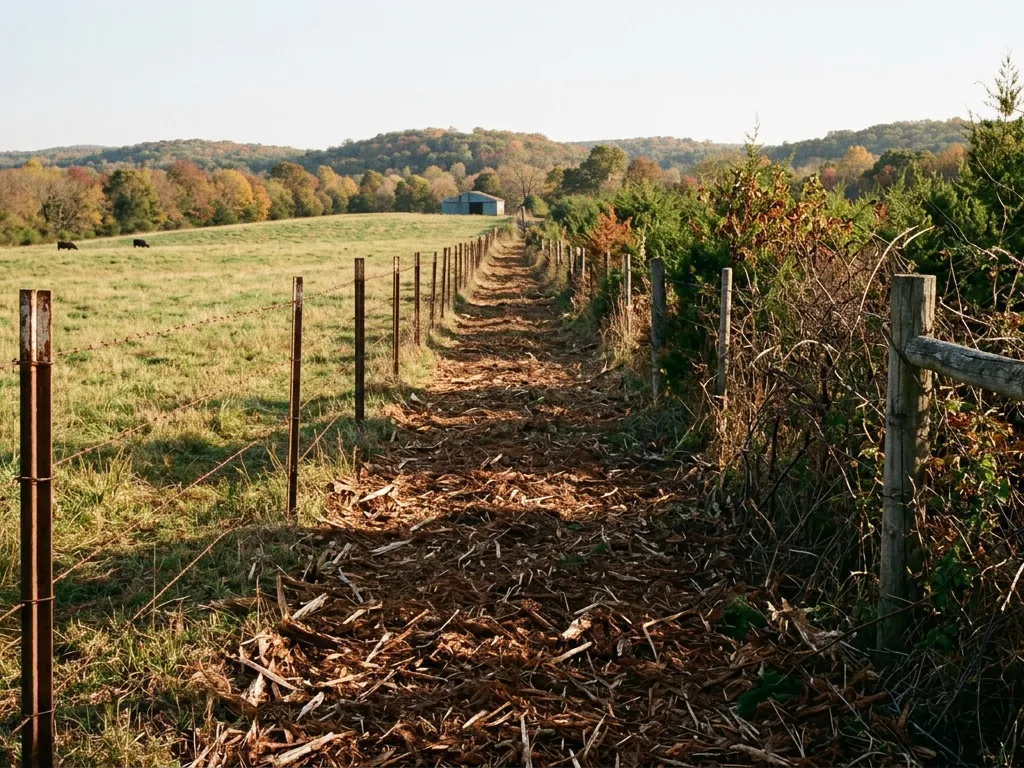
Around Springfield, bush hogging mostly means fescue pasture, hay field margins, fence rows and the strip along a lane that nobody mowed last season. The cutter takes grass, weeds, briars and brush stems up to about thumb thickness, and it leaves the cut material lying on the ground to dry. Because eastern red cedar does not resprout from a cut stump, regular mowing keeps young cedar out of a field. Sumac, hardwood sprouts and blackberry come back from the roots, so the mower has to keep coming back too.
Bush Hogging Cost per Hour and per Acre in Missouri
No national cost guide prices bush hogging on its own, so these figures come from the University of Missouri Extension custom rate survey (G302, revised 2026), which reports what Missouri operators charged in 2025. They rest on few responses: seven operators reported the brush mowing rate and five the pasture rate, and the guide itself warns that low counts limit confidence. Rough, rocky or sloped ground mows slower and costs more per acre. Ask for the rate in writing, by the hour or by the acre, and ask whether there is a minimum.
$50 to $175 per hour
Mowing brush or overgrown pasture, per hour (Missouri). These are Missouri survey figures from few responses (University of Missouri Extension G302), and density, rock, slope and the size of the field move a given job most.
| Job | Typical range | Figure from |
|---|---|---|
| Mowing brush or overgrown pasture, per hour (Missouri) | $50 to $175 per hour | MU Extension G302, 2026 |
| Mowing pasture or CRP ground, per acre (Missouri) | $12 to $25 per acre | MU Extension G302, 2026 |
| Forestry mulching, per hour | $125 to $300 per hour | HomeGuide, 2023 |
| Forestry mulching, per acre | $400 to $800 per acre | HomeGuide, 2023 |
Bush Hog or Forestry Mulcher: An Honest Comparison
A bush hog is cheaper by the hour and quick on open ground, and many farm tractors already run one. It struggles with anything much thicker than a thumb, leaves shattered stems and sharp stubs, and kills nothing that grows back from the root.
A forestry mulcher grinds saplings and small trees into a chip layer, and a drum head takes stumps down to about ground level. It costs more per hour, but on ground gone to thicket one pass replaces seasons of mowing that never catches up. The fair rule: mow what a mower can cut, mulch what it cannot, then go back to mowing. The trade-offs are laid out in forestry mulching vs bush hogging.
Chert, Hidden Wire and the Permit Question
The soil mapped at Ozark and Sparta is a Goss gravelly silt loam, and chert turns up in fields across the area. A rotary cutter's blades take a beating on rock, old fence wire and stumps hidden in tall growth, so walk a neglected field and flag what you find first. On permits, mowing cuts above the ground. Greene and Christian County draw their land disturbance line at work that disturbs the root zone of existing vegetation, and normal farming activity is generally outside the county permits; confirm with the county if the ground is being reshaped.
Timing the Mowing on a Greene County Field
Once or twice a year keeps most pastures clear, cutting regrowth while the stems are still small enough for the cutter. Wet silt loam ruts under a wheeled tractor, so mowing waits for ground that holds the tires. If a field has gone several seasons without a mower and saplings spring back up after the tractor passes, it is past bush hogging: brush clearing or pasture reclamation comes first, and mowing takes over afterward.
Fields That Still Suit a Bush Hog
- Grass and weeds past knee height, but no real trees yet
- Briars and sprouts thinner than your thumb
- A pasture that was mowed every year until recently
- Weeds taking over the edge of a hay field
- Fence rows starting to fill with sprouts
- Young cedar seedlings coming up in the open
Schedule Bush Hogging in Springfield
Call and describe the field, the growth and the acreage, and ask whether a rotary cutter or a mulcher is the right tool for it.
Call (417) 759-5914Bush Hogging Available In
Springfield and the qualifying towns inside the 20-mile service area.
Related guides: Land Clearing Cost Per Acre in Springfield.
Frequently Asked Questions
Bush Hogging Questions in Springfield
How much does bush hogging cost per acre in Missouri?
University of Missouri Extension's custom rate survey puts mowing pasture or CRP ground at $12 to $25 per acre and mowing brush or overgrown pasture at $50 to $175 per hour. Few operators reported those rates, so treat them as a rough Missouri guide.
What is the difference between a brush hog and a forestry mulcher?
A brush hog (bush hog) is a tractor-pulled rotary cutter that chops grass, weeds and light brush. A forestry mulcher grinds saplings and small trees into mulch and can take stumps to about ground level. The mulcher costs more per hour but handles growth a cutter cannot.
How often should a pasture be bush hogged?
Once or twice a year keeps most pastures from going to brush. Mow while regrowth is small; waiting until it is past the cutter's size means paying for clearing first.
Do I need a permit to bush hog my land?
Mowing cuts above ground and does not disturb the root zone, which is where Greene and Christian County draw the line for their permits. Normal farming activity is generally outside the county permits; confirm with the county if the ground is being reshaped.
Will bush hogging kill cedar trees?
Cedar does not resprout from a cut stump, so mowing young cedar keeps it out of a field. Cedar already too big for the cutter needs a saw or a mulcher.