
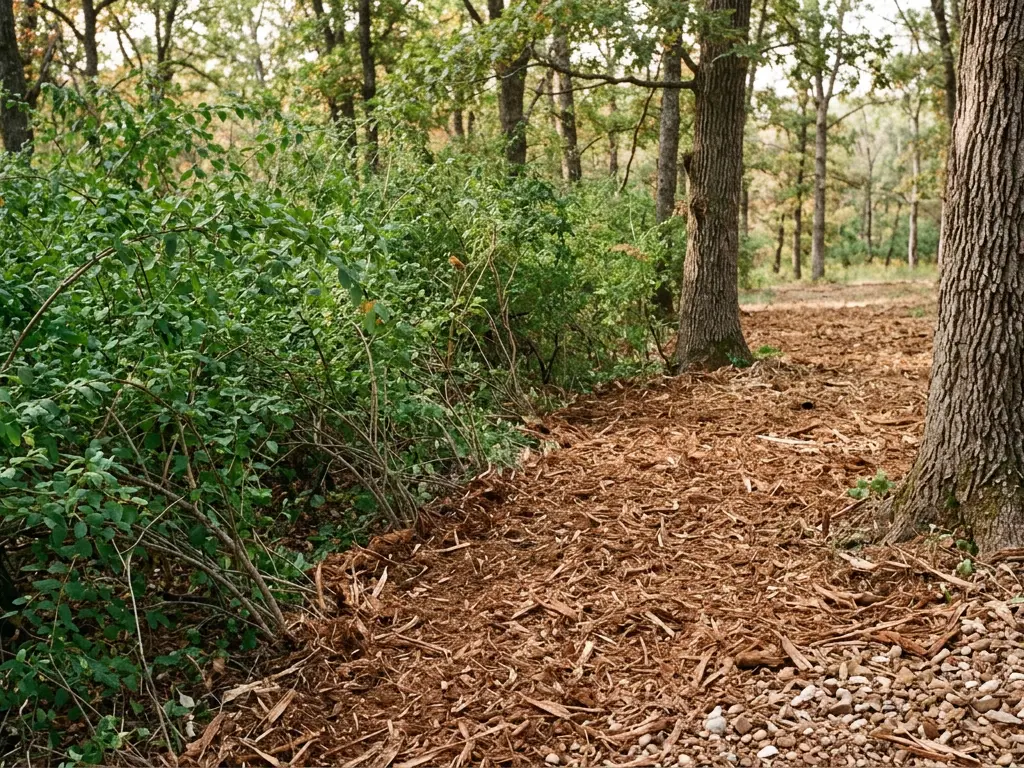
Briars, sumac and thicket
Land Clearing Springfield MO: Brush Clearing in Springfield
Thick brush is the cheapest kind of overgrowth to clear, as long as it is cleared before it turns into trees.
- Springfield and 10 nearby townsGreene and Christian County, all within 20 miles
- Licensed, insured local contractorsWe work with them; ask for proof before work starts
- Written price firstPer-acre ranges published on every service page
- Calls answeredMonday to Saturday, 7am to 6pm
Land Clearing Springfield MO arranges brush clearing and brush removal across Springfield and the surrounding towns: the blackberry and briar tangles, sumac, buckbrush, young cedar and sapling thickets that take over any ground left unmowed for a few years. The work is usually done with a forestry mulcher or a heavy rotary cutter, and the only real decision is whether the cut brush stays on the ground as mulch or is hauled away.
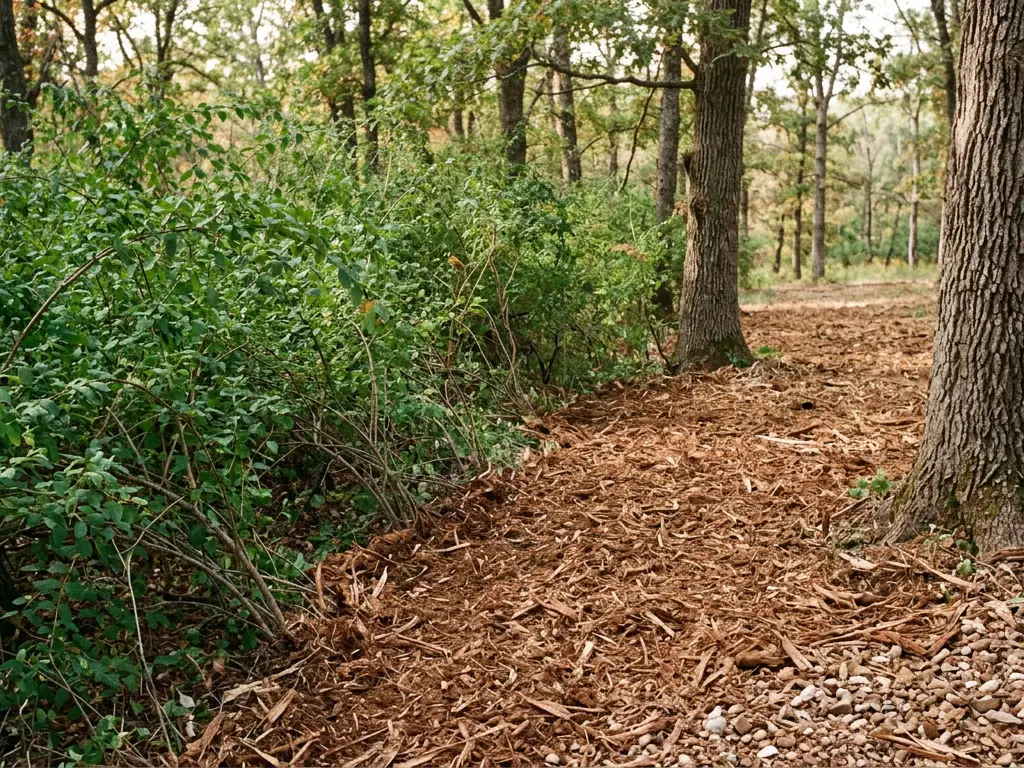
Light brush clears for $800 to $1,800 an acre; the same ground grown to half brush and half trees runs $1,600 to $3,000 an acre, and left as woods it runs $2,500 to $5,000.
Typical price
$800 to $1,800 an acre
Clearing light brush runs $800 to $1,800 an acre, heavy brush with scattered trees $1,600 to $3,000, and wooded ground with brush $2,500 to $5,000 (HomeGuide brush removal guide, January 2026). Minimum charges of $250 to $600 a visit are common. Hauling brush piles away runs $150 to $200 a pickup-truck load.
Get a price: (417) 759-5914Brush that has outgrown the mower
- Briars and blackberry canes taller than your waist
- Sumac and buckbrush spreading in patches
- Saplings that bend back up after the tractor passes
- A bush hog that stalls or breaks shear pins
- Ticks and chiggers every time you walk it
- Brush hiding rock, stumps or old wire
Mulch it or haul it
For most brush, mulching is the cheaper answer, because it removes the cost of loading, hauling and dumping, and the chips protect the soil while grass comes back. Hauling makes sense on a city lot, a yard, or anywhere the owner wants bare ground or plans to seed immediately. A pickup-truck load holds 2 to 4 cubic yards of brush, and a thick quarter acre can produce many loads.
A rotary cutter on a tractor is the other common tool. It is fast on light brush and cheaper to run than a mulcher, but it leaves stems shattered rather than ground, and it struggles with anything much thicker than a thumb.
Brush on slopes and near water
Brush on a creek bank or a steep draw is often holding the soil. Clearing it to bare ground invites a gully the first heavy rain. Mulching leaves cover in place, and leaving a strip along the water is cheaper than repairing the bank later. In a mapped floodplain, Greene and Christian County both require a floodplain development permit for soil disturbance, and mulching above ground is far less likely to count as one than grading.
Tell us the acreage and what is growing on it, and hear a typical price range before anyone drives out.
Call (417) 759-5914Keeping it from coming back
Brush regrows from roots. One clearing buys a season or two; keeping it open takes mowing at least once a year, grazing, or spot herbicide on resprouts. The cheapest long-term plan is to clear once properly, then mow before the regrowth gets past a mower's size. Most of the brush calls around Strafford and Rogersville are fields that were cleared once and then left.
Questions people ask
How much does brush clearing cost per acre?
Light brush runs $800 to $1,800 an acre, heavy brush with some trees $1,600 to $3,000, and wooded brush $2,500 to $5,000 (HomeGuide, January 2026).
What are the signs brush has gotten too big to mow?
Saplings that spring back after the tractor passes, a bush hog that stalls or breaks shear pins, and briars taller than your waist. Past that point it is a mulcher job.
Is it cheaper to mulch brush or haul it away?
Usually mulching, because it removes loading, hauling and dump fees. Hauling runs $150 to $200 a pickup-truck load, which adds up fast on a thick lot.
Can I burn the brush piles?
Outside city limits, Missouri allows burning land clearing vegetation more than 200 yards from the nearest occupied structure. Inside Springfield you need the city's $84 open burning permit.
How do I keep brush from coming back?
Mow at least once a year before regrowth gets big, graze it, or spot-treat resprouts with herbicide. Brush regrows from roots, so one clearing alone does not end it.
Often done together
- Forestry mulchingOne machine cuts, grinds and spreads brush and small trees as mulch. No piles, no burning, no bare dirt.
- Debris removalEvery clearing job ends with the same question: what happens to the piles. There are four answers, and the rules pick most of them for you.
- Pasture reclamationA hay field or pasture lost to brush can be grazed again within a season, if the clearing is followed by seed and a mower.
- Land Clearing Springfield MO: Land Clearing in StraffordFarm ground east of Springfield where brush comes back faster than anyone can mow it, on soils that hold water in spring.
Tell us what is growing and how much of it
Say roughly how many acres, what has taken over (cedar, honeysuckle, brush, saplings, a grown-in fence row) and what you want the ground to become. You will hear which method usually fits and what it tends to cost per acre before anyone drives out.
Call (417) 759-5914