
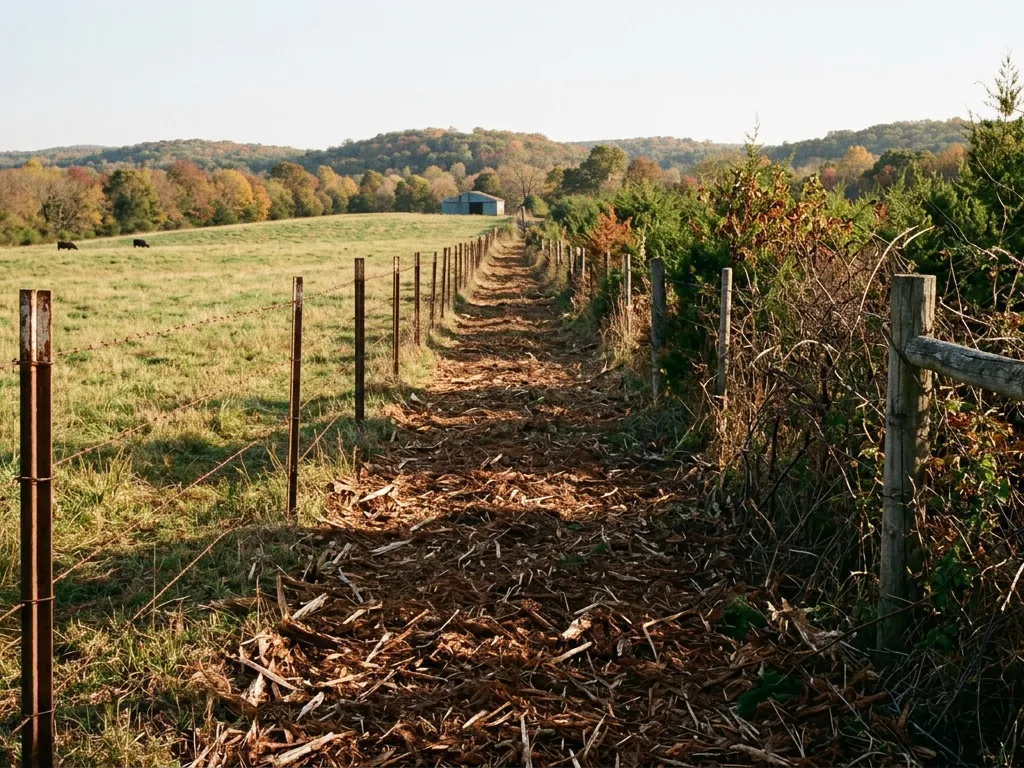
Land Clearing Pros of Springfield MO: Fence Line Clearing in Springfield, MO
A fence row grows in faster than the field beside it, and clearing a strip either side of the wire gets the fence back.
- Springfield and 20 miles around
- Licensed, insured local contractors
- Typical price ranges on every page
- Ask for a written price first
- County permit rules explained
Land Clearing Pros of Springfield MO explains fence line clearing for farms and acreage around Springfield: cutting and mulching the trees, cedar and brush that grow up along a fence until the wire is buried, posts are pushed over and nobody can drive the line. It is usually done ahead of a fence repair or replacement, or to open a lane wide enough to check the fence from a UTV.
Clearing a fence row by machine runs $125 to $300 per hour; leave it until the trees have grown into the wire and the fence itself fails, and every tree in the row becomes tree removal at $400 to $1,200 per tree, before the new fence is even priced.
Why Fence Rows Grow In First on Springfield Farms
Birds perch on the wire and drop seeds, mowers cannot reach right up to it, and cattle cannot graze under it. So the strip under every fence becomes a nursery for cedar, hackberry, Osage orange, sumac and blackberry.
Left alone for a decade, a fence row becomes a hedge, and the trees in it start lifting posts and stretching wire. Cedar in the row also seeds the field beside it, which is why fence rows and cedar tree removal go together.
Fence Line Clearing Cost: Time, Trees and Wire
A forestry mulcher with an operator is billed by the hour or the day, so the cost per thousand feet comes down to how fast the machine can move along the row. Brush and saplings go quickly; trees grown into the wire go by hand and slowly.
Taking the old fence out first is its own line: MU Extension's custom rate survey puts the median paid for fence removal at $1.25 per foot, from few responses. Ask for an estimate per thousand feet after the row has been walked, in writing before work starts.
$125 to $300 per hour
Forestry mulching, per hour. Fence line work is usually priced by time, and how many feet an hour buys depends on the size of the trees in the row and whether the old wire stays up.
| Job | Typical range | Figure from |
|---|---|---|
| Forestry mulching, per hour | $125 to $300 per hour | HomeGuide, 2023 |
| Forestry mulching, per day with operator | $1,000 to $2,500 per day | HomeGuide, 2023 |
| Tree removal, per tree | $400 to $1,200 per tree | HomeGuide, 2025 |
| Typical minimum charge | $400 to $600 minimum | HomeGuide, 2023 |
| Mobilization (hauling the machine in) | $150 to $300 per visit | HomeGuide, 2023 |
Saving the Fence or Replacing It
If the fence is staying, the mulcher works each side of the wire, and the trees actually grown into it are cut by hand so the wire is not torn. That is slower and the price reflects it. If the fence is being replaced, it is usually cheaper to pull the old wire first, then clear a clean strip with the machine and set new posts on open ground.
A strip of about ten feet each side leaves room for a fence crew and a mower.
Wet Ground Along Fence Rows East of Springfield
The soil under a fence row decides when a machine can work it. Around Strafford, the USDA soil survey maps Needleye silt loam, somewhat poorly drained with a fragipan about 23 inches down. Around Rogersville it maps Splitlimb silt loam, frequently ponded.
On ground like that a tracked machine in a dry spell leaves the strip smooth enough to mow, while the same pass after rain can leave ruts along the whole line.
Boundary Fences and the Neighbor
A boundary fence belongs to both sides in practice. Before clearing one, agree with the neighbor on how wide the strip is on each side and who pays for what, in writing if it is a big job.
If the fence may not sit on the true line, a land survey ($500 to $1,500) settles it before anyone cuts trees that might be on the other property.
Signs a Fence Row Has Gotten Away From You
- Trees growing through the wire or wrapped around it
- Posts leaning where roots have pushed them
- Cedar, hackberry and sumac in a solid wall along the line
- Livestock finding gaps you cannot see to fix
- No room to drive or walk along the fence
Schedule Fence Line Clearing Around Springfield
Decide whether the wire stays or goes, agree the strip width with any neighbor, and ask for a written price per thousand feet before work starts.
Call (417) 759-5914Fence Line Clearing Available In
Springfield and the qualifying towns inside the 20-mile service area.
Related guides: Tree Clearing and Bats in Missouri: When to Cut and Clearing Land Without Heavy Equipment Near Springfield.
Frequently Asked Questions
Fence Line Clearing Questions in Springfield
How much does fence line clearing cost?
It is usually priced by time: $125 to $300 per hour or $1,000 to $2,500 per day for a forestry mulcher with an operator (HomeGuide). The cost per thousand feet depends on tree size and whether the wire stays.
What are the signs a fence row needs clearing?
Trees growing through the wire, leaning posts, a solid wall of cedar and brush, livestock finding hidden gaps, and no room to walk or drive the line.
Can a fence row be cleared without damaging the fence?
Yes, but trees grown into the wire have to be cut by hand, which is slower. If the fence is being replaced, pull the wire first.
How wide should a cleared fence line be?
About ten feet each side of the wire gives room for a fence crew, a mower and a UTV, and keeps brush off the fence longer.
Who is responsible for clearing a boundary fence?
Agree it with the neighbor first. If the fence may not be on the true boundary, have it surveyed before clearing.