
Permits guide
Land Clearing Springfield MO: Land Disturbance Permits in Springfield and Greene County
The machine decides more than the acreage does. Here is which office covers your land and what triggers its permit.
- Springfield and 10 nearby townsGreene and Christian County, all within 20 miles
- Licensed, insured local contractorsWe work with them; ask for proof before work starts
- Written price firstPer-acre ranges published on every service page
- Calls answeredMonday to Saturday, 7am to 6pm
Land Clearing Springfield MO publishes this guide for property owners and builders around Springfield who want to know whether a clearing job needs a permit before it starts. It covers the Greene County grading permit, the Christian County soil erosion control permit, Springfield's land disturbance program, the Missouri Department of Natural Resources permit for sites over an acre, and the sinkhole, floodplain and burning rules that sit alongside them. Rules change, so confirm the current version with the office named before relying on any of it.
The root zone rule in both counties
Greene County's Environmental Division, part of Resource Management, says a grading permit application is required for any non-agricultural land disturbance. Christian County's Planning and Development office uses almost the same words for its soil erosion control permit. Both define land disturbance as all activity that disturbs the root zone of existing vegetation, and both give the same example: clearing trees with a dozer requires a permit, and clearing trees with a chainsaw does not.
That example is the key to most clearing decisions. Cutting above ground and leaving roots in place sits on the chainsaw side of the line. Pushing trees over, grubbing stumps, root raking and grading sit on the dozer side. Forestry mulching that leaves the roots in the ground is often the way to clear brush without disturbing the root zone, but confirm it for your property rather than assuming.
What counts as agricultural
The county permits cover non-agricultural disturbance, so normal farming activity sits outside them. Both counties say pond construction is considered agricultural unless soil leaves the property, which requires a grading permit, or the pond is in a Special Flood Hazard Area. Clearing pasture for grazing is the kind of work the exemption is for. Clearing for a house, a shop, a subdivision or a commercial building is not.
Tell us the acreage and what is growing on it, and hear a typical price range before anyone drives out.
Call (417) 759-5914Over one acre, the state permit
The Missouri Department of Natural Resources issues construction land disturbance stormwater permits for work that disturbs one or more acres, or less than an acre when it is part of a larger common plan of development. Both counties ask for a copy of the state permit with the grading application on sites over one acre. The state permit comes with a stormwater pollution prevention plan, usually called a SWPPP, describing the erosion and sediment controls on the site.
Inside Springfield and the other cities
Springfield requires a land disturbance permit for sites disturbing one acre or more, or less than an acre when part of a larger common plan that will disturb one acre or more over the life of the project. Since March 1, 2024, the city has been a Qualifying Local Program for land disturbance permitting, so developers inside Springfield no longer need both a state and a city permit. The city also says all construction sites must comply with City Code Chapter 96, Land Disturbance Activity, regardless of size.
Other cities run their own programs inside their limits. Republic issues land disturbance permits under its stormwater permit, and Nixa has its own land disturbance, illicit discharge and erosion control ordinance. Inside any city, ask the city first.
Sinkholes
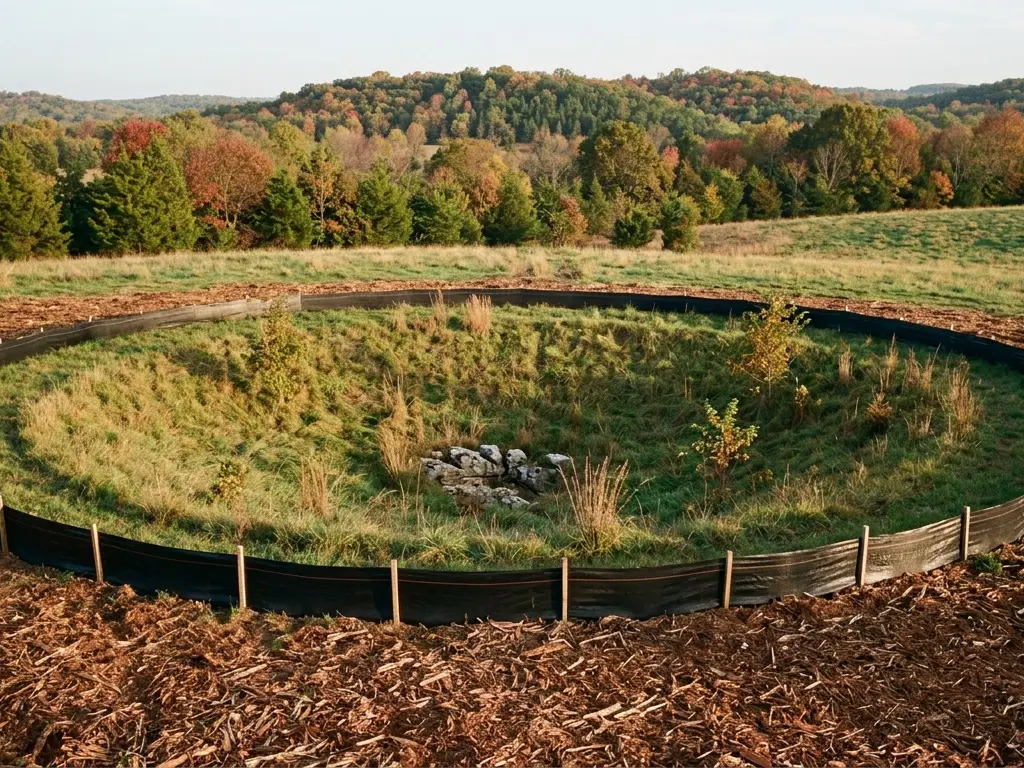
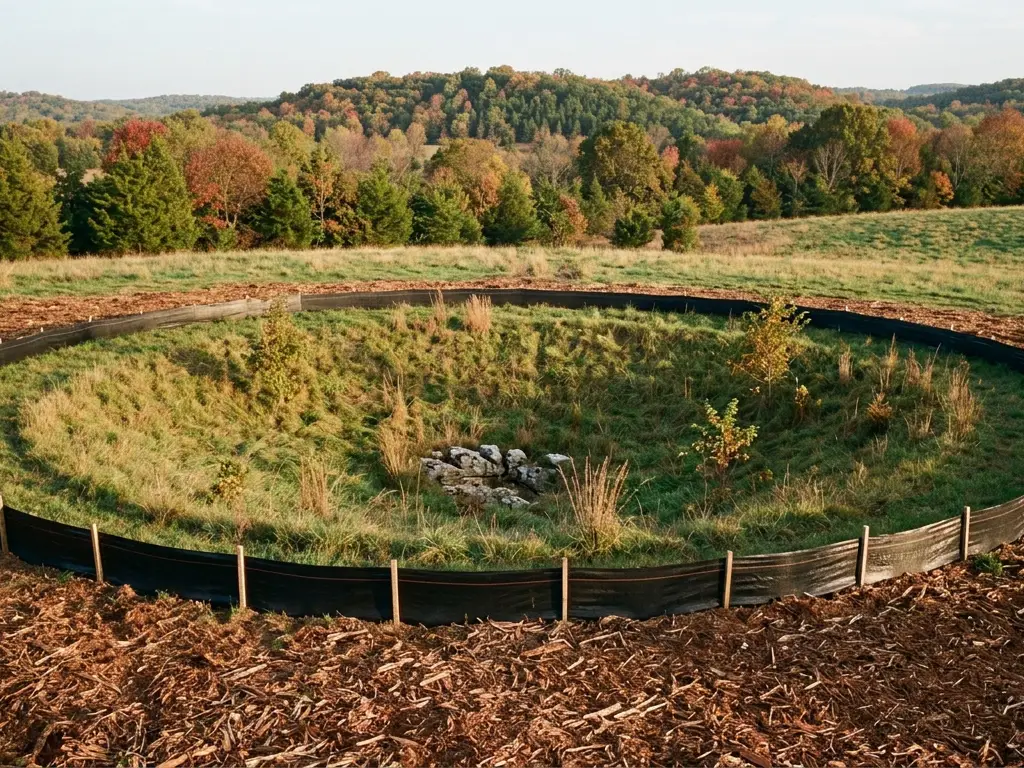
Greene County sits on karst, and its design standards give sinkholes their own rules. The sinkhole flooding area, the part that fills in a storm, can be estimated conservatively as the ground below the low point on the sinkhole rim. During construction, existing ground cover is not removed within 25 feet of the sinkhole flooding area, and a silt barrier is erected and maintained around the outer edge of that buffer. Where water reaches the sinkhole as sheet flow, a permanent vegetated buffer at least 25 feet wide around the flooding area satisfies the water quality requirement.
In practice, a clearing crew should flag every sinkhole and its buffer before the machine starts, and leave the buffer alone.
Not sure whether you need mulching, grubbing or a full clear? Most people are not. Call and describe the ground.
Call (417) 759-5914Floodplains
Both counties require a separate floodplain development permit for activity in the Special Flood Hazard Area, the mapped floodplain. Christian County's wording covers any soil disturbance or development activity there. Land along the James, the Finley and their tributaries, and many smaller creek bottoms, falls inside mapped floodplain. Check the county's flood map before clearing near water.
Burning the debris
Inside Springfield's limits, open burning of trees, brush and vegetation needs the city's open burning permit, $84, initially approved for three months and extendable to a year at the same site. Only vegetative waste from the site may be burned, never leaves; burning runs sunrise to sunset with someone attending, winds under 15 mph, the fire department called for daily approval, and the pile out each evening. Commercial land clearing burned inside the city within 200 yards of a structure the burner does not own must use an air curtain incinerator.
Outside city limits, Missouri's open burning rule allows land clearing burns without an air curtain incinerator when the burn is more than 200 yards from the nearest occupied structure, and tires or used oil may never be used.
Who pulls the permit
Either the owner or the contractor can apply, depending on the office. Settle it in writing before work starts, along with who installs and maintains the silt fence and who calls for inspections. A contractor who has never heard of the root zone rule is a contractor to ask more questions of.
Questions people ask
Do I need a permit to clear land in Greene County?
For non-agricultural work that disturbs the root zone, yes: Greene County requires a grading permit. Clearing trees with a dozer needs one; clearing with a chainsaw does not, by the county's own example.
When is a Missouri land disturbance permit required?
For construction that disturbs one or more acres, or less as part of a larger common plan of development. Inside Springfield, the city administers it as a Qualifying Local Program.
Does forestry mulching need a grading permit?
Mulching that cuts above ground and leaves roots in place is closer to the chainsaw example than the dozer one, but confirm with the county, especially near sinkholes or floodplain.
How close to a sinkhole can I clear?
Greene County's design standards keep existing ground cover in place within 25 feet of the sinkhole flooding area during construction, with a silt barrier around the buffer.
How much is a burn permit in Springfield?
The City of Springfield's open burning permit is $84, valid initially for three months and extendable up to a year for the same site.
Is building a pond agricultural?
Both counties treat pond construction as agricultural unless soil leaves the property or the pond is in a Special Flood Hazard Area.
Tell us what is growing and how much of it
Say roughly how many acres, what has taken over (cedar, honeysuckle, brush, saplings, a grown-in fence row) and what you want the ground to become. You will hear which method usually fits and what it tends to cost per acre before anyone drives out.
Call (417) 759-5914