Land Clearing Pros of Springfield MO: Clearing Land Without Heavy Equipment Near Springfield
Land Clearing Pros of Springfield MO wrote this guide for property owners around Springfield who want to clear land by hand before paying for a machine. Clearing land without heavy equipment works well on a short list of jobs: pulling young honeysuckle, cutting and treating larger stems, dropping saplings and opening a fence row. It stops working on stumps, roots, big trees and acreage, and knowing where that line sits saves both a sore back and a wasted season.
What hand clearing does well
| Job | Hand method | Works by hand? |
|---|---|---|
| Honeysuckle seedlings | Pull the whole plant when the soil is moist | Yes |
| Honeysuckle shrubs | Cut at the base, treat the stump right away | Yes, with follow-up |
| Cedar saplings | Lopper or chainsaw at ground level | Yes, cedar does not resprout from a cut stump |
| Hardwood saplings | Cut, then treat or mow the sprouts | Partly, they resprout from the roots |
| Fence rows | Saw and lopper along the wire | Yes, for a few hundred feet |
| Stumps, roots, acreage | None practical | No |
The pattern is simple. Anything small enough to pull, or anything that dies when cut and treated, is a hand job. Anything that comes back from the roots, or has to come out of the ground, is not.
Pulling and cut and daub for bush honeysuckle
Bush honeysuckle is the most common target for hand clearing around Springfield, and the Missouri Department of Conservation's control page is the guide to follow. MDC says seedlings may be hand-pulled when soils are moist, and that all of the root should come out or the plant will resprout. Spring after a soaking rain is the easy time to pull.
For shrubs too big to pull, MDC says stems can be cut at the base with brush cutters, chainsaws or hand tools, and that a 20 percent glyphosate solution applied to the cut stump, sprayed or wiped on with a sponge, prevents resprouting. Treat each stump immediately after cutting. MDC notes that the Roundup and Rodeo labels list a higher concentration for stump work, so read the label on the product you buy, and remember glyphosate kills any plant it touches. Expect some resprouts and plan a follow-up treatment.
MDC also says hand-pulling smaller plants or grubbing out large ones should not be used in sensitive habitats, because pulling opens the soil. Where the plants come out, underplanting natives may be needed to fill the gap. Late fall is the easy season to find honeysuckle: it stays green after the native plants go dormant.
Saplings, cedar and fence rows
Young cedar is the best hand job on most properties. Cut it at the ground and it is gone, because cedar does not resprout from a cut stump. On a rocky glade, MDC's glade page describes cutting heavy cedar with a chainsaw and letting it cure for a year before burning.
Hardwood saplings are different. Hardwoods and honeysuckle resprout from the roots, so a cut sapling becomes a clump of sprouts unless the stump is treated or the sprouts are mowed down each year.
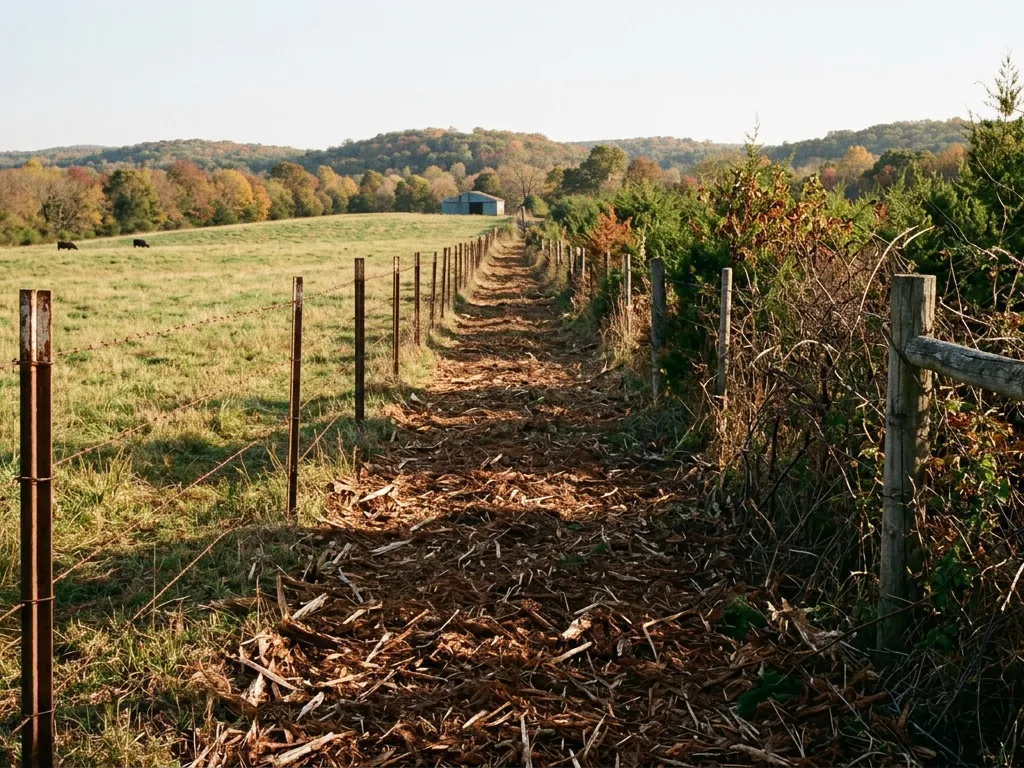
A fence row is a fair weekend project when the growth is still brush and the trees are small enough to fell safely away from the wire. If the old fence has to come out too, University of Missouri Extension's 2026 custom rates guide reports a median of $1.25 per foot for fence removal, from only a few responses. See fence line clearing for what a full fence row job involves. An old farm fence row around Strafford or Fair Grove that has grown into a line of trees is past hand work.
Where hand clearing stops
- Stumps. A saw leaves a stump at ground level at best. Getting it below grade takes a grinder, and stump grinding runs $100 to $250 for the first stump, then $30 to $60 per added stump.
- Roots. A house pad, drive or septic field needs the roots out, and hand tools cannot grub a root ball.
- Big trees. A tree large enough to hit a roof, a line or a fence when it falls is a job for someone insured for it, at $400 to $1,200 per tree.
- Acreage. Hand work runs $50 to $80 per hour as hired labor. Past a fence row or a backyard edge, a forestry mulcher at $400 to $800 per acre is usually cheaper than paying hands to do the same ground.
- Thickets. Dense honeysuckle across a whole woods is mulcher work, with the stumps treated after.
If the job has gone past that line, brush clearing and forestry mulching explain the machine options.
Past the point of hand tools? Describe the stumps, trees or acreage that are left, and ask for a written price for just that part of the job.
Call (417) 759-5914Permits for chainsaw clearing
Hand clearing has one real advantage beyond cost: in most cases it does not trigger the county permit. Greene County requires a grading permit for any non-agricultural land disturbance, defines land disturbance as activity that disturbs the root zone of existing vegetation, and gives its own example: clearing trees with a dozer requires a grading permit, but clearing trees with a chainsaw does not. Christian County's soil erosion control permit uses the same definition and the same example.
Inside Springfield, the city runs its own land disturbance program, with a permit for sites disturbing one acre or more. If you plan to dig, grade or pull roots anywhere, call the county or the city before you start, not after.
Burning what you cut
Inside Springfield, burning brush needs the city's open burning permit. The city's application says only vegetative waste from the site may be burned, not leaves, refuse or trade waste, between sunrise and sunset, with winds under 15 mph all day and the fire department called for approval each day. If structures owned by someone else stand within 200 yards, those owners sign an acknowledgment. The Springfield burn permit rules page has the full list.
Outside city limits, the Missouri Department of Natural Resources' open burning fact sheet allows yard waste to be burned on the premises where it grew, and it bars tires and used oil from starting or feeding any fire. Fire protection districts may add their own burn bans, so check with yours. If you cut cedar, MDC warns that burning several cured cedars together can produce a fire hot enough to damage trees nearby, so keep piles small and well away from the trees you are keeping.
A sensible order of work
- Walk the ground in late fall and flag the honeysuckle, which is still green.
- Pull seedlings after a soaking rain and cut and treat the shrubs.
- Drop the cedar and the saplings, and treat the hardwood stumps.
- Pile, chip or burn the brush under the rules for your address.
- Price the leftovers, the stumps, big trees and thickets, as machine work.
Questions about a piece of ground near Springfield? Call (417) 759-5914
Sources
- Missouri Department of Conservation, Bush Honeysuckle Control
- Missouri Department of Conservation, Glades and Balds
- Greene County Resource Management, Environmental Division
- City of Springfield, Land Disturbance Permit
- City of Springfield, Application for Open Burning Permit (Rev. 7/2020)
- Missouri Department of Natural Resources, Facts on Open Burning Under Missouri Regulations (PUB2047)
Frequently Asked Questions
Clearing Land Without Heavy Equipment Near Springfield: Questions
How do you clear land without heavy equipment?
Pull small honeysuckle when the soil is moist, cut larger stems and treat the stumps, and cut cedar and saplings with a lopper or chainsaw. Stumps, roots and acreage need a machine.
Can you clear land by hand?
Yes, for brush, saplings, honeysuckle and fence rows. Hand tools cannot remove stumps or roots, so ground that will be built on needs machine work.
Does clearing trees with a chainsaw need a permit near Springfield?
Greene and Christian counties both say clearing trees with a chainsaw does not need their grading permit, while clearing with a dozer does. Inside Springfield, ask the city.
Will honeysuckle come back after I cut it?
Yes, unless the cut stump is treated. MDC recommends a 20 percent glyphosate solution on the stump right after cutting, and a follow-up treatment for resprouts.
When does it make sense to hire a machine instead?
When the job is more than a fence row or a yard edge. Forestry mulching runs $400 to $800 per acre, which is usually less than paying labor at $50 to $80 per hour to clear the same ground.